In this tutorial, you can learn how to troubleshoot issues with Flexmonster Data Server. To check if a solution to your issue already exists, see the Common issues with the Data Server guide.
Start troubleshooting the Data Server with the following steps:
Step 1. Check the Data Server logs for additional information.
Step 2. See if your issue is in the list of common issues.
Step 3. Take a look at our release notes to see if your issue was fixed in one of the newer Data Server versions. If the issue was fixed, update the Data Server.
Step 4. Search for support tickets with a similar issue.
Step 5. Completely reinstall the Data Server and check if the issue is still present. See how to uninstall the Data Server as a service, as a console application, or as a DLL.
Step 6. Report the issue if it occurs after following the previous steps.
If the troubleshooting did not help you resolve the issue, raise a support ticket and provide the following information:
Learn how to check the Data Server version depending on how the Data Server is used:
If you are using the Data Server and Admin Panel 2.9.53 or later, open the Help tab and find the Data Server version under the Server Version label.
The Admin Panel 2.9.52 and earlier shows only its version under the Version label. In this case, check the Data Server's version via a browser.
Open the Data Server's address (e.g., http://localhost:9500) in the browser, where the Data Server's version will be displayed:

Open the Data Server's address (e.g., http://localhost:9500) in the browser, where the Data Server's version will be displayed:

Flexmonster.DataServer.Core package to check its version: 
dotnet list package
Flexmonster.DataServer.Core and its version in the list of top-level packages: 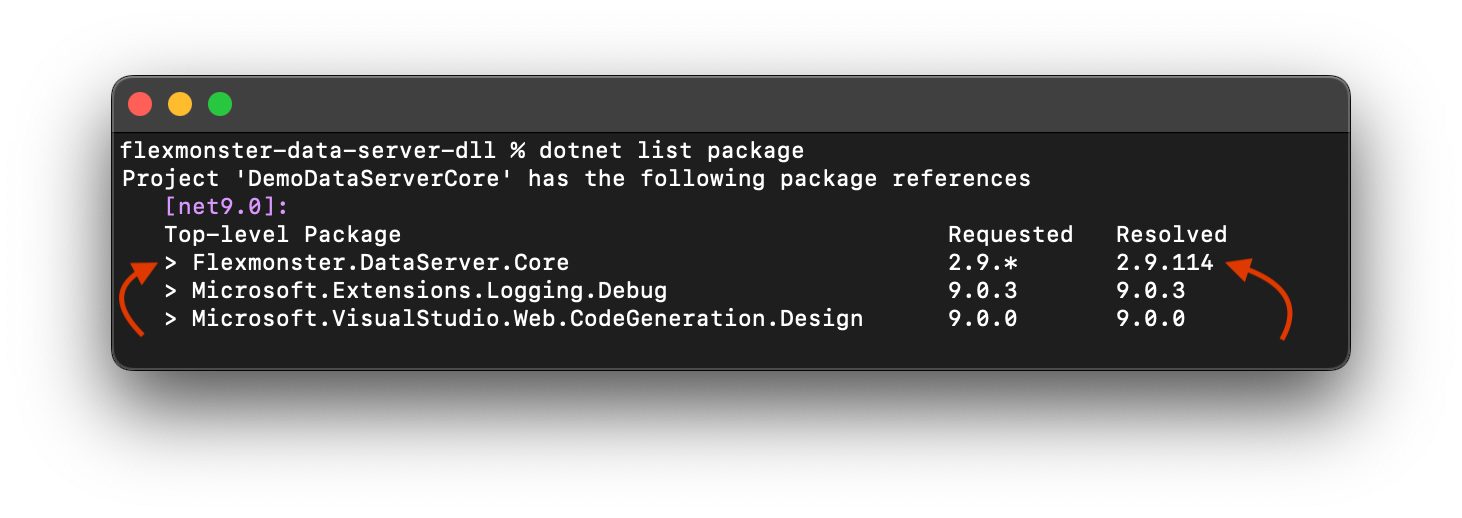
The Data Server logs contain diagnostic data that can help identify the cause of the issue. Here is how to find the logs depending on how you use the Data Server:
The Data Server logs are stored in the logs/ folder. It can be accessed from the Admin Panel:
logs/ folder in the file manager.You can also access this folder directly by going to the flexmonster-data-server/ folder.
Note If you have been using the Data Server prior to version 2.9.58, another possible location of the logs is the following folder:
C:/ProgramData/FlexmonsterDataServer/logs/.~/.local/share/FlexmonsterDataServer/logs/ (will resolve to /home/[current_user]/.local/share/FlexmonsterDataServer/logs/).
To access the Data Server logs, go to the flexmonster-data-server/ folder and open the logs/ subfolder.
Note If you have been using the Data Server prior to version 2.9.58, another possible location of the logs is the following folder:
C:/ProgramData/FlexmonsterDataServer/logs/.~/.local/share/FlexmonsterDataServer/logs/ (will resolve to /home/[current_user]/.local/share/FlexmonsterDataServer/logs/).
Can't find your answer?
Visit the FAQ
Flexmonster Pivot Table & Charts is a JavaScript pivot table component for adding interactive reporting and data analysis to web applications. Users can summarize, filter, sort, and explore data in pivot tables and charts, drill into results, and export reports.

